Choose remarkable initiatives to back

Managing financing rounds, grants, residencies, awards becomes a transparent and intuitive process

Discover possibilities
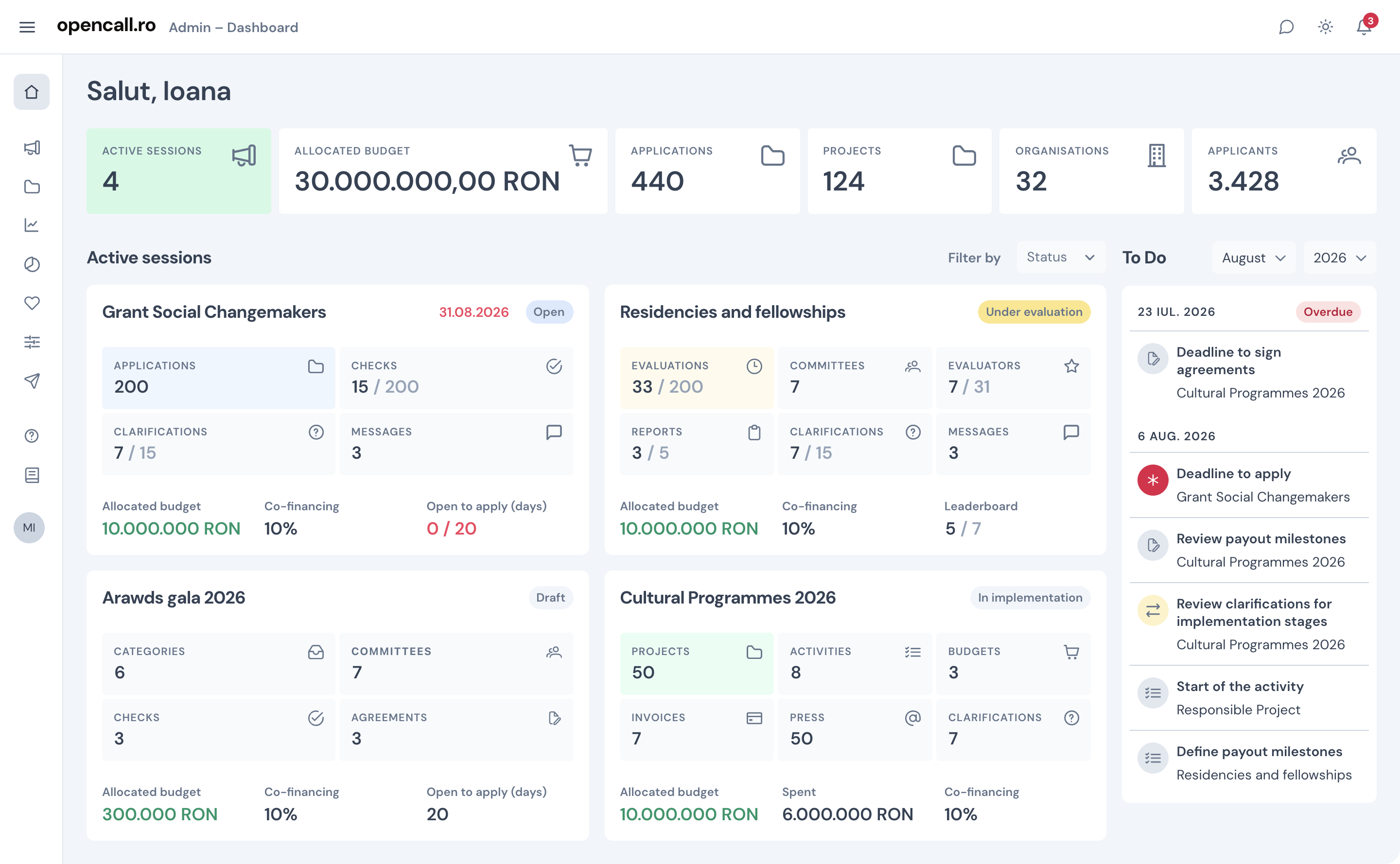
OpenCall admin dashboard — active sessions, applications and calendar

One place for all your funding calls. Opencall.ro is your partner in running programmes such as grants, scholarships and awards.

Grants

You offer money for a project, as much as it asked for and as much as it deserves, within the fund. The committee evaluates the project and its budget, and after the decision come the contract, instalments, expenses and reports.

Scholarships and residencies

You offer the same amount to every winner. The committee evaluates a person and their plan and chooses who takes the places, and after the decision come a short contract, fixed instalments and a final report.

Awards

You offer recognition: a place on the podium. The committee evaluates work already done, in two rounds, shortlist and final, and after the decision comes the public announcement of the winners.

Thank you so much for the experience so far. Everything has been very well organized, professional, fuss-free, and supported by a platform with great UX. Congrats!

Jury member

Women in Marketing Awards

What OpenCall does

  1. Form builder — Build the form right in the platform, around what the call needs. Every question gets the right field: number, date, list, checkboxes, documents, person. Fields can appear conditionally, only when they matter. The budget is built into the call’s template, and the platform calculates the totals. An application that is incomplete, over a budget cap or missing required fields cannot be submitted.
  2. Applicant portal — Applicants work on the application together, as a draft. Colleagues are invited by email, and every change saves automatically and updates the progress bar. On submission, the application gets a unique code and an email confirmation. Applicants know it has arrived, without having to call. Clarifications are requested for each field or document, with a deadline to reply. Applicants answer directly in the platform, not by email or phone. Applicants submit as an organisation or as an individual. The organisation’s profile is filled in once and reused for the next calls. From one call to the next, applicants build a reputation: a record of everything they submitted and how each application ended.
  3. Easy evaluation — Every call has its own criteria. You set them per panel, with weights or a maximum score, and choose how the score is calculated. Jurors are invited to the panel by email and see only their panel’s applications, without the applicants’ contact details. You open and close the evaluation for each panel. Jurors score directly in the platform. The score is calculated automatically, and the summary board builds the ranking. In the summary board, the overview of applications shows who has scored and who hasn’t. Once you publish the evaluation results, each applicant sees their scores, anonymised, and the panel’s reasoning on their application.
  4. Customisable, traceable process — The whole call runs in the platform, from submission to settlement. No parallel records in email and Excel. Every application has a history: who did what, and when. In an appeal or an audit, you show step by step how the decision was reached. The process follows your rules: verification steps, contracts, the constraints set for each session. For the next edition, you clone the session. Forms, templates, evaluation criteria and settings come with it.
  5. Communication channels — Applicants and your team talk directly in the application, through chat. Files sent there can be moved into the application form. Clarifications requested on fields reach the applicant as a notification, in the platform and by email. Notifications go out at every step of the call, from submission to results. In the FAQs, you answer a question once, and the answer appears on the public questions page, for all applicants. You send bulk messages only to the applicants who need them, by session, category or status. And users send you feedback directly from the platform.
  6. To-dos, calendar, deadlines — What you need to resolve, and by when, sits on the dashboard, not in Excel or in someone’s memory. The list updates itself: what is resolved disappears, what is overdue stays in sight. Each task takes you straight to the application. You set deadlines on clarifications and documents. Overdue items show in red. Every active session, or one in implementation, has its own card: days left, applications scored, contracts, reports. Applicants see their own deadlines and get an automatic reminder to sign the contract. They know what to do next, without phone calls.
  7. Contracts — You define the contract’s Word template once: you mark in it where the data from the call form goes. Contracts are then generated for every funded application, without anyone filling them in by hand. The approved budget is attached to the contract as an annex. With partial funding, the beneficiary redoes the budget for the amount granted, and you approve it before signing. You set the instalments, percentages and contract length for each category. They can be fixed or chosen by the beneficiary, with a cap on instalments. Contract details are requested only from those who are funded. The signing deadline is tracked in the platform. The signed and countersigned contracts stay in the application.
  8. Project monitoring — See at any time who has reported and who hasn’t. The dashboard shows the reports submitted and those approved. Beneficiaries report each activity as they complete it, and overdue deadlines stay in sight. Every expense is uploaded against a budget line. The amount spent is calculated against the budget, without Excel. Beneficiaries have access to your logos and communication kit. The project’s promotional materials are sent for approval. Projects with activities open to the public send you their events through the platform. The ones you choose can appear on your website.
  9. Reporting and settlement — Settlement invoices are uploaded against their instalment. The whole team, finance included, sees the same settlement. Each invoice is either accepted or gets a clarification request. Payment is marked only on accepted invoices. You see on each one whether it has reached SPV. The report form has the required fields you set. An incomplete report cannot be submitted. You approve it or ask for changes.
  10. Statistics and connections — The figures for the annual report, for your funder or for an audit are already calculated, for one session or for all of them. Comparing sessions, you see what needs to change in the call’s rules: how much is requested against how much is approved, where applications get stuck, how long each step takes. The connections graph shows how people, projects, organisations and partners are linked. Evaluation has its own statistics: the spread of scores, the averages per criterion, who has scored and who has given reasons. We are working on methods that show the panel where scores diverge, and on evaluation algorithms chosen to fit each session’s needs.
  11. Security, privacy, GDPR — You decide for how long, and to which data, evaluators have access. They will see only their panel’s applications, without the applicants’ contact details. Each role sees only what it needs. Sensitive data no longer travels by email. Files open only through links that expire. Every change leaves a trace, deletions included: who changed what, and when. Your data is kept apart from other clients’ data. Uploaded files go through an antivirus, and the platform is tested and monitored continuously.

The platform that makes the entire grantmaking process configurable, transparent, digital, traceable and intuitive

OpenCall.ro takes an open call from launch to finish, for the funder, the applicant and the evaluator, in one system. No hassle, no ring binders, overflowing inbox or constant phone calls.

They chose to open calls on OpenCall.ro

Centrul Cultural PlaiFundația Comunitară TimișoaraOAR Timbrul ArhitecturiiWomen in Marketing CEE

Everything you back can grow.